Lab-Created Grape Varieties: What It Really Means
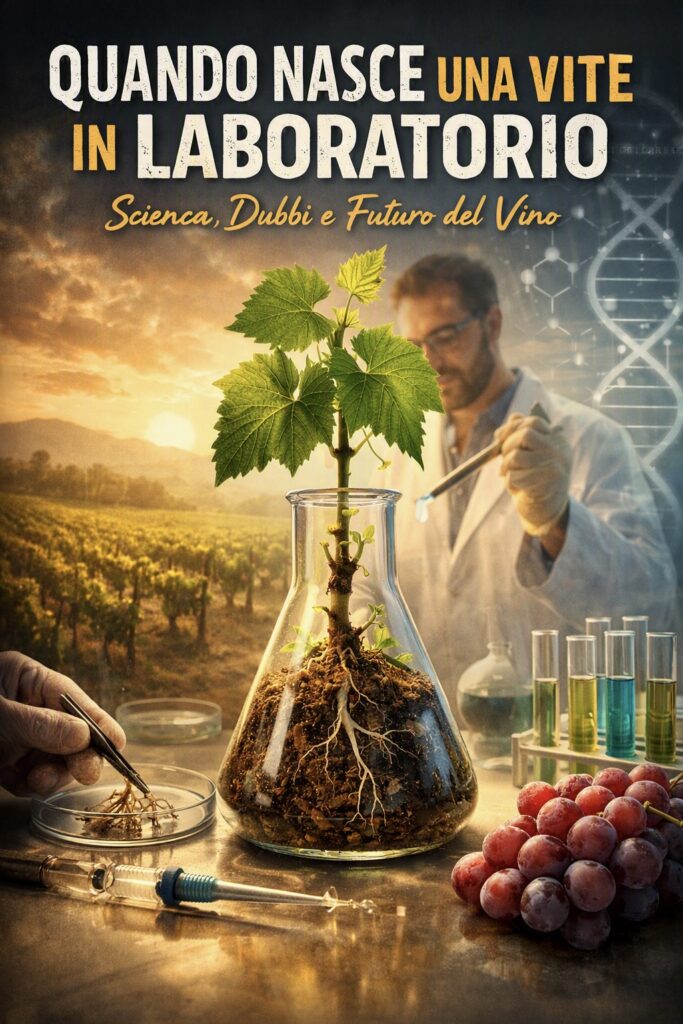
You know, I don’t really know where to begin. Maybe with the fact that for years, I took it for granted that the vine was an ancient creature—something that grows as it pleases, changes when it decides to, and allows itself to be touched only by time and by winemakers who look at it the way you look at a wild animal. Then one day, I discover that’s not the case. I discover that today, a vine can be born… in a lab. And for a moment, my breath caught.
I’m not talking about science fiction, or those scary words like “OGM. I’m talking about real scientists, with real hands, working on a plant we’ve known for millennia, trying to give it a sort of armor, an extra chance. And as I read about it, as I listen, I can’t help but think: so wine is no longer just soil, season, and luck. It is also a choice. It is also human ingenuity.
Why Lab-Created Grape Varieties Are Born
The answer is almost obvious, if you think about it for a second. The vine is fragile. Fragile like something that shouldn’t be fragile, because you imagine it strong, rooted, eternal. Instead, every year is a war: downy mildew, powdery mildew, flavescence dorée. And every year, you spray, you protect, you scramble for remedies.
So someone said: “What if we tried to create one that doesn’t get sick so easily?” And that’s how the famous PIWIs were born—those grape varieties that resist disease as if they had learned to defend themselves.
Then there is the climate, which by now has become a character in its own right. It does whatever it wants. And the vine, poor thing, can’t always keep up. So, varieties are born that ripen later, that don't burn, and that hold onto their acidity even when summer seems like it will never end.
And then there’s something that really struck me: science can help to save ancient grape varieties.the ones that are disappearing. You take those relic biotypes, those surviving in three forgotten rows, cross them with more stable varieties, and a new vine is born, carrying a piece of memory inside. Like a child who resembles an ancestor no one has ever seen.
Concrete examples, so we don't just stay in the theoretical
The PIWI: Solaris, Bronner, Souvignier Gris, Regentyou can find them in Trentino, Alto Adige, Friulithese are vines that barely get sick. And the wine? Different, yes. But surprisingly good.
Then there are Fleurtai, Soreli, Nermantis, Termantis. Names that sound like they came out of a video game, but they are real. And they work.
And then, there are those born to save ancient grape varieties. Here, science becomes almost a love story: you take a dying vine, cross it with a stronger one, and give it a second life. A new life, but with a memory inside.
The lingering doubt: terroir
And here, I admit, I stop. Because wine isn’t just agronomy. It is identity, memory, territory—it is everything that cannot be measured with a graph.
And so, the question arises on its own: If a grape variety is born in a lab, can it truly have a terroir?
I don’t know. And maybe no one really knows. Some say yes, because terroir is about the place, not the DNA. Others say no, because the grape variety is part of history, and if you change it, you change everything.
Honestly, I don't have an answer. I only have a feeling: that viticulture is entering new territory, where science doesn't replace nature, but tries to dialogue with it. Sometimes well, sometimes poorly. Just like in any complicated relationship.
The Future of Lab-Created Grape Varieties
Maybe these grape varieties will never be the protagonists. Maybe they will remain on the sidelines, as useful tools when needed. Or maybe they will become normal, like so many things that seemed strange at the beginning.
"What is certain is that they open a door. A door that forces us to ask ourselves what we truly want from wine: tradition? sustainability? resilience? all of them together?
And perhaps, precisely within this dialogue between past and future, between vines saved and vines created, there lies the perfect space for Rediscovered Vines. Because telling the story of the vine means telling the story of humanity.
And humanity, today, creates.
And saves
And makes mistakes.
And tries again.
Article by: Mister Wine – Giovanni Scapolatiello – Sommelier Ais
Follow me on Instagram: @giomisterwine